Videographer
And
Editor
: marisa srijunplang
Videographer
And
Editor
: marisa srijunplang
Videographer
And
Editor
: marisa srijunplang
Videographer
And
Editor
: marisa srijunplang

When the dust flew away (2025)

Photo of my mother, sister, and grandmother.
"This work is about memory, how it fades, how it lingers, and how it shapes the ones left behind. It begins with my grandmother and my mother, two women bound by war in different ways. My grandmother survived the Cambodian war in 1975, only to develop dementia years later. My mother took care of her while also raising her sister’s children who had lost their parents. Now, my mother is the one losing her memories, and my sister and I are the ones taking care of her. I often wonder if she feels the same way she did when she was looking after my grandmother, if she senses the weight of time shifting, just as I do now.
I grew up surrounded by the quiet strength of these women; my grandmother, my mother, my sister. My sister and I helped care for my grandmother as children. Back then, we were told she had a mental illness, a phrase that hovered over our home without explanation. Only later did we understand that she had dementia, that it was not just an illness but a slow erasure, a quiet vanishing. My mother carried that weight, just as we are carrying it now.
The space around us has absorbed these changes. My mother’s home, once filled with the rhythms of daily life, is now covered in dust. The garden has grown wild, vines pushing their way through windows, trees taking root in places once carefully tended. The reminders of her past are still there. The notes scribbled to help her remember, photographs yellowing in the quiet, but they are becoming relics of a life she is slowly forgetting. When she first became ill, she moved to a new house. The home I grew up in, the place where all of this history unfolded, is empty now, left behind just as the past is slipping from her mind.
There is a stillness in this, a sense of time pausing but never stopping. The weight of memory loss is not just in forgetting, but in watching someone disappear in pieces, in realizing that one day, they may not remember who you are. It feels like a slow kind of mourning, one that stretches across years. I see this not only in my family but in the empty houses around our neighborhood, spaces abandoned after the elderly passed away, their children having moved on to different lives.
This work is my way of holding onto these moments, of exploring what it means to care for someone who is slipping away. It is about grief, but also about love, about resilience, about the quiet ways we carry those we have lost within us. Even as memories fade, something remains an imprint, a presence, a connection that endures beyond forgetting."
By
Marisa Srijunpleang
" When the dust flew away , 2025”
Part of Exhibited in “Many Faces of Her”,
CURATED BY ROSE BANNAROS,
organized by 333artlink and Noble Play,
Bangkok, Thailand.


Photograph taken while cleaning my mother's house.

Old clothes and flower-making tools found while cleaning my mother’s house
and The process during the making of the sculpture

sculpture sketch
" This series consists of four sculptures, with the first three created by pressing a mixture of talcum and “Mon Leya powder” onto Makha wood window frames. These imprints preserve traces of objects, holding memories of presence and absence. My mother often sat in silence by the window, her communication fading until only simple words remained. That window became a witness to her stillness and the home she left behind when she fell ill. Cleaning the space, I found time frozen dust settling, trees growing through windows, and her handwritten notes fading. The house, once a place of safety, was surrounded by walls lined with glass shards, a barrier she built after my father passed to protect the home and those inside.
One of my earliest memories as a child, is caring for my grandmother, bathing her and applying talcum powder before school. Powder, used by both the young and the elderly, became a symbol of caregiving passed through generations. Through this work, I use powder as a sculptural medium to preserve these layers of care and presence. The window frames hold my mother’s quiet gaze, the house bears witness to time passing, and the powder captures the gestures of women who cared for one another across generations."
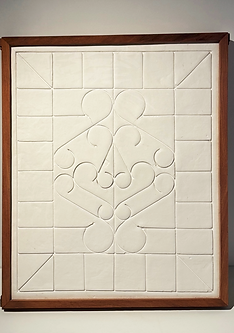
Be engraved, 2025
Printing objects (wrought iron) onto powder,
112x93x8.5 cm

Be engraved, 2025
Printing objects (old curtains) onto powder
106x67x8.5 cm
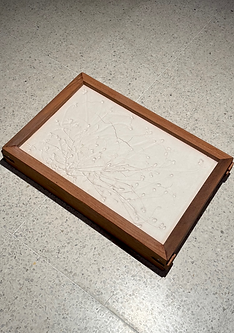
Be engraved, 2025
Printing wild Gomphrena flowers that grow through concrete onto powder. 40x60x8.5 cm
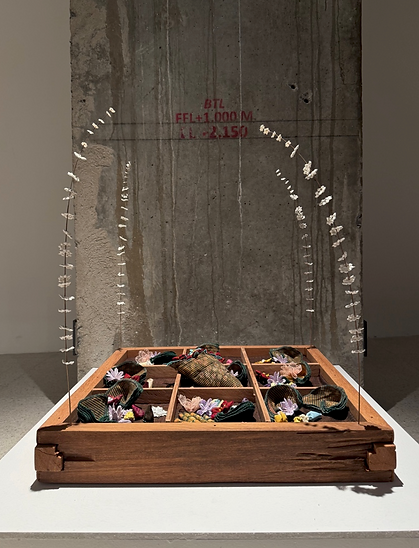
Left behind and no turning back, 2025
57x57x8.5 cm. Sewing fabric, folding flowers, Old fabric scraps.
"The final sculpture is inspired by the traditional krathong with nine compartments used in ceremonies. It features a wooden base made from window frames and fabric elements crafted from my mother’s old clothes and leftover scraps found while cleaning her home.
In traditional belief, using an ill person’s old clothes in rituals helps ward off misfortune. While organizing my mother’s house, I found her lace fabrics, phathung, and remnants of my mother’s clothing. My mother once worked as a seamstress, and fabric was always part of her life. This piece reflects those memories, the act of repurposing what was left behind, and the quiet ritual of letting go. "

INSTALLATION VIEW PHOTO
PHOTO SIMPLE OF VIDEO WORK :
*CLICK ON THE IMAGE TO WATCH THE FULL VIDEO*

10.01 Minute
This video work consists of two parts.
" The first part captures the process of cleaning my mother’s house. Family members slowly dust off the surfaces, clearing away the stillness that has settled over time. The camera lingers on quiet details. The trees growing into the house, the dust covering her belongings, the curtains untouched in the same position, the notes she wrote to remind herself of things she can no longer remember. It follows the process of deciding what to keep and what to let go, carefully placing her things back as they were. Over this, a conversation unfolds between my mother, my sister, and me. After finishing the cleaning, we sit together, looking through old photographs, trying to piece together memories, holding onto whatever she can still recall. The video ends with the burning of discarded items, a quiet farewell to what no longer belongs.
The second part documents a Khmer-Thai ritual from Surin, performed to ward off misfortune and call back the spirit of a sick person to their family. It is a ceremony often done in times of unease, when the body or the spirit feels distant. At the center is a krathong made of banana leaves with nine compartments, filled with food, fruits, flowers, and small figurines representing wandering spirits. The video focuses on the final moments of the ritual, as voices rise together, calling my mother’s spirit back to her family and offering blessings for protection and healing. "
*THIS SERIES CONSISTS OF ONE VIDEO WORK AND FOUR SCULPTURES.*